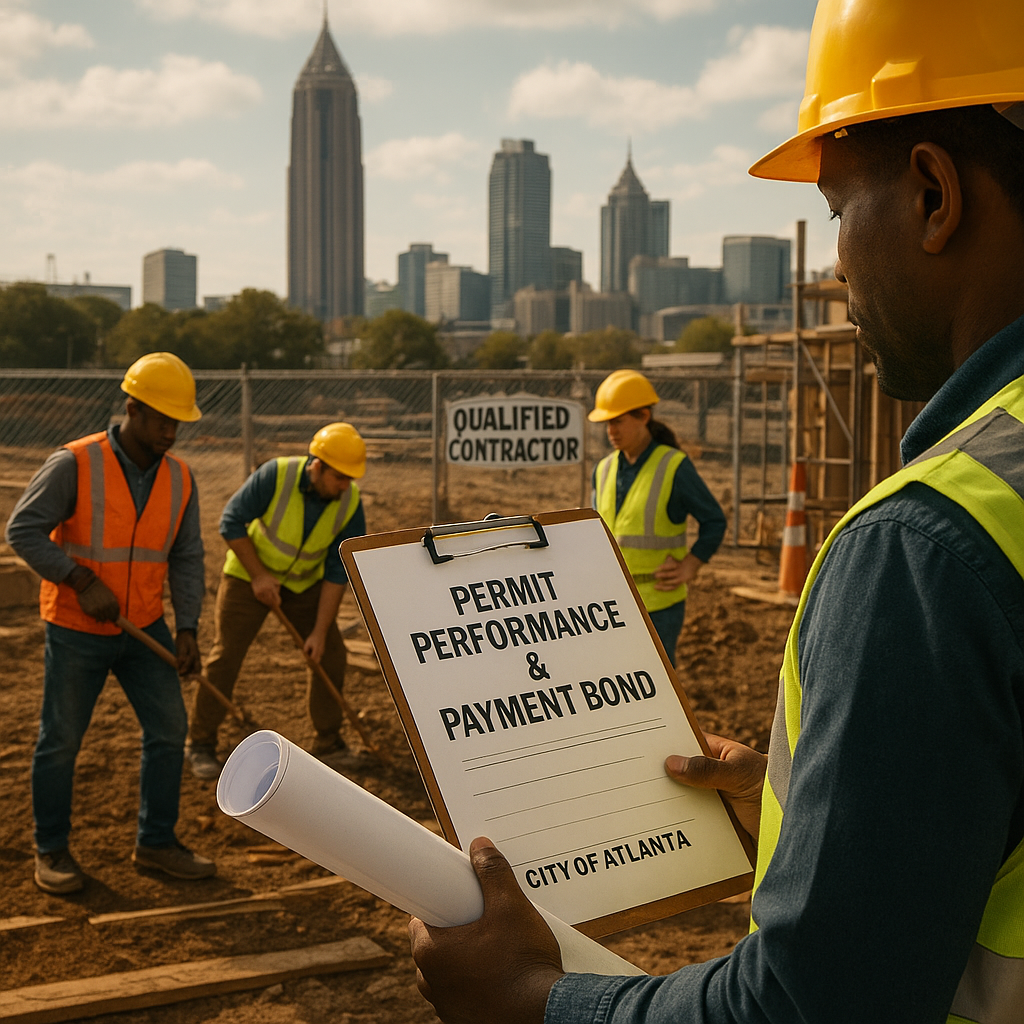
What’s the Real Deal Behind Permit Performance Bonds?
Picture this: You’re finally ready to pour that long-awaited driveway, patio, or commercial foundation in Atlanta. You’ve found a trustworthy concrete contractor, the price is right, and the permit is pulled. But then you hear the words “performance and payment bond” and wonder, “Is that just extra paperwork, or does it actually protect me?”
If you’re a concrete contractor working in the City of Atlanta, you’ve likely already faced this question head-on. The city’s requirement for a Qualified Contractor Permit Performance & Payment Bond isn’t a bureaucratic hurdle—it’s a powerful promise. Think of it like a safety deposit box that holds accountability in place, ensuring the job gets done right and everyone gets paid fairly.
Breaking It Down: What Exactly Is This Bond?
Let’s ditch the legal jargon. A permit performance bond is essentially a three-party agreement that guarantees a contractor will complete a project according to the terms laid out in the permit and the contract. The payment bond portion does something equally vital: it promises that subcontractors, material suppliers, and laborers will be paid for their work and supplies.
Imagine you hire a band to play at an event. You sign a contract, but to feel extra secure, a trusted friend steps in and says, “If the band doesn’t show up, I’ll cover the cost to find a replacement.” That friend is acting like a bond. The City of Atlanta acts as the entity requiring this guarantee, the contractor is the one who must perform, and the bonding company backs the promise financially.
For concrete contractors specifically—those whose work involves foundations, flatwork, retaining walls, and heavy structural elements—the stakes are high. A botched concrete pour isn’t just unsightly; it can be dangerous and astronomically expensive to fix. This bond provides a structured safety net that goes far beyond a handshake.
Why Atlanta Insists on Qualified Contractor Bonds
Atlanta’s construction scene is booming. With that growth comes a need for tighter oversight. The city’s Qualified Contractor program separates the true professionals from those who might cut corners. By mandating a permit performance and payment bond, the city does a few things at once:
- Filters for financial stability: Bonding companies conduct thorough checks on a contractor’s credit, business history, and track record. If a contractor can secure a bond, it’s a green flag that they’re financially responsible.
- Protects homeowners and developers: If a contractor abandons a job mid-pour or fails to meet code, the bond can step in to cover the cost of completing the work.
- Shields subcontractors and suppliers: The payment bond makes sure the concrete supplier who delivered the mix or the pumping service that helped with the pour gets their due, even if the general contractor faces financial trouble.
This isn’t just red tape—it’s a community safeguard. A City of Atlanta GA Qualified Contractor wearing that compliance badge is telling the world, “I’ve been vetted, and I stand behind my work.”
How the Bond Works in Real-Life Concrete Projects
Let’s make this tangible. Say a concrete contractor pulls a permit to build a 2,000-square-foot parking pad in a Buckhead neighborhood. They must secure a bond as part of the permit approval. Halfway through the project, the contractor unexpectedly walks off, leaving the site a mess of half-finished grading and exposed rebar. The homeowner feels helpless. Here’s where the performance bond kicks in. The homeowner can file a claim against the bond. The bonding company investigates, and if the claim is valid, it hires another qualified contractor to finish the job without extra charge—up to the bond amount.
Meanwhile, the payment bond side ensures that the concrete truck driver who delivered 10 loads of ready-mix doesn’t become an unpaid creditor. This two-pronged protection turns the bond into a full-circle security system.
The Concrete Contractor’s Angle: Not Just Another Expense
Many contractors initially see the bond requirement as just another permit fee. But those who lean into compliance quickly realize it’s a competitive advantage. When homeowners compare bids, a contractor who can say “I’m a qualified, bonded contractor with the City of Atlanta” stands out immediately. It’s like a restaurant displaying a health inspection grade of A on the window—you know immediately that they care about doing things the right way.
Moreover, having a bond often improves a contractor’s internal processes. They become more diligent about documentation, subcontractor agreements, and project timelines because they know a claim could affect their ability to get bonded in the future. In a way, the bond nudges everyone toward better business habits.
What Does “Compliance Only” Mean?
You might have spotted the phrase “Concrete Contractor – Compliance Only” attached to certain bond references. This typically indicates a bond required strictly to meet municipal regulations, not an additional private contract requirement. In Atlanta, the Qualified Contractor Permit Performance & Payment Bond is exactly that—a compliance-only bond mandated by the city. It’s non-negotiable if you want to pull a permit for concrete work. While the city sets the minimum bond amounts, contractors can often adjust coverage based on the project’s scale. Understanding this nuance helps contractors avoid overpaying for coverage they don’t need while still staying fully compliant.
Navigating the Path to Becoming a Qualified Contractor
If you’re a concrete contractor looking to meet Atlanta’s requirements, the process doesn’t have to be overwhelming. Think of it as a three-step rhythm:
- Step 1: Get your business finances in order. Bonding companies will look at your credit score, company profitability, and experience level. The healthier your numbers, the better your bond rate.
- Step 2: Work with a surety bond agency familiar with Atlanta GA Qualified Contractor Permits. They’ll guide you through the exact bond amount the city demands for your specific concrete scope—whether it’s a small residential patio or a multi-level commercial parking deck.
- Step 3: File the bond with the city alongside your permit application. Once approved, you’re in the pool of qualified contractors. Display that compliance proudly—on your website, bids, and job site signs.
Pro tip: Build a relationship with your bond provider. As your business grows and takes on larger projects, having a reliable bond partner makes scaling up seamless. Need a higher bond limit for a big mixed-use development? That ongoing relationship can speed up approvals and keep premiums manageable.
Common Pitfalls and How to Steer Clear
Not every contractor gets it right the first time. Here are a few traps to avoid:
- Underestimating the bond amount: The city of Atlanta has minimums, but larger jobs may need more coverage. Always double-check the permit requirements for each project.
- Ignoring the payment bond’s value: A performance bond alone won’t protect you from a lien placed by an unpaid concrete supplier. Make sure your bond package covers both performance and payment obligations.
- Letting the bond lapse: A bond tied to a permit must stay active for the duration of the project plus any warranty period. Renew on time to keep your permit valid and avoid costly stop-work orders.
- Assuming all bonds are the same: A generic license bond is different from a permit performance bond. Confirm you have the exact type the City of Atlanta asks for to maintain your qualified status.
Why Homeowners Should Ask: “Are You Bonded?”
If you’re planning a concrete project, you hold more power than you think. Before signing a contract, ask point-blank: “Can you provide proof of your City of Atlanta Qualified Contractor Permit Performance & Payment Bond?” A legitimate, compliant contractor will happily share documentation. If you get hemming and hawing, consider it a red flag the size of a cement truck.
This single question can save you from nightmare scenarios where you’re left paying twice—once to the original contractor who failed and again to someone else to fix the mess. With a bonded contractor, your investment has a built-in recovery mechanism. Peace of mind isn’t just a luxury; it’s a concrete slab you can walk on for decades.
The Bigger Picture: A Culture of Trust in Atlanta Construction
When the City of Atlanta reinforces standards like these permit bonds, it does more than regulate. It shapes a culture of accountability and excellence. Concrete contractors who consistently meet bonding requirements elevate the entire industry’s reputation. Neighbors talk. Online reviews reference reliability. Soon, being a qualified, bonded contractor becomes the baseline expectation—not the exception. That’s a win for everyone who lives, works, and builds in this vibrant city.
So whether you’re a contractor looking to elevate your credibility or a property owner seeking a smooth construction experience, understanding the role of the Performance & Payment Bond is a step toward smarter, safer decisions. It transforms a simple permit into a powerful pledge—one that says, “I’ll do what I promised, and if I can’t, there’s a plan B.” In the hard-wearing world of concrete, that kind of certainty is solid gold.