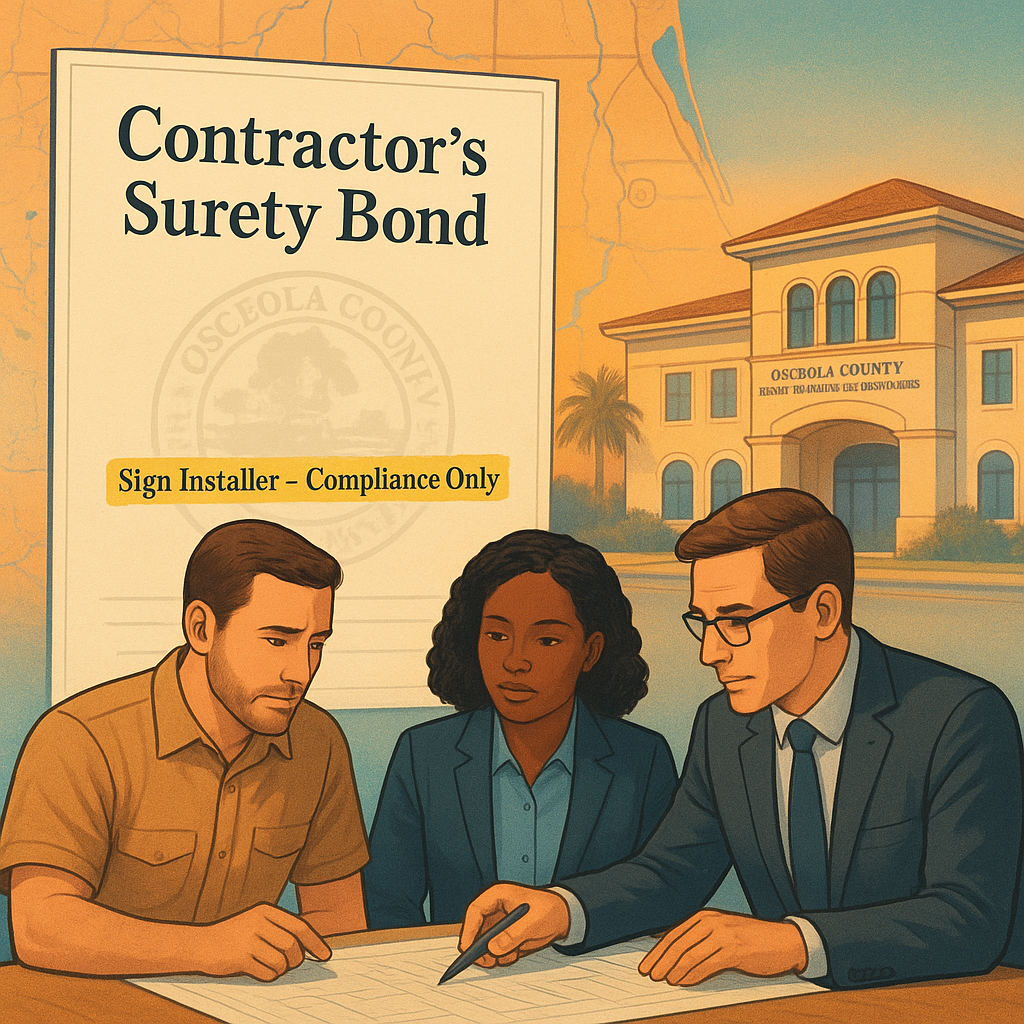
If you’ve ever driven through Kissimmee, St. Cloud, or the growing corridors of unincorporated Osceola County, you’ve seen the signs. And I don’t just mean the road signs—I mean the towering monument signs for shopping centers, the illuminated channel letters for new medical offices, the wayfinding signs for master-planned communities. Someone has to install those safely and by the book. That’s where a specialized group of contractors comes in: sign installers. But before they can pull a permit and get to work, there’s a critical piece of paper they need—something called a sign installer surety bond.
Maybe you’re a sign company owner trying to land a project near Lake Nona or the Turnpike. Or maybe you’re a business owner who just leased a storefront and you’re wondering why your sign guy asked about “bonding.” Either way, understanding the Osceola County contractor compliance rules—and the role of the surety bond—can save you from headaches, delays, and unexpected costs. Let’s break it all down in plain English.
What Exactly Is a Sign Installer Surety Bond?
Think of a surety bond as a three-party promise. The first party is the principal—that’s the sign installer or the contracting company. The second is the obligee—the entity requiring the bond, which in this case is the Board of County Commissioners of Osceola County, FL. The third party is the surety—the insurance-like company that backs the bond financially.
This isn’t insurance for the contractor. It’s a guarantee to the county and the public that the sign installer will follow all the applicable codes, regulations, and safety standards. If they don’t, a claim can be made against the bond to cover damages or correct violations. In Osceola County, the required bond is a “compliance only” bond. That phrase is key. It means the bond is focused on making sure the contractor obeys the rules—not on guaranteeing that the sign looks amazing or that the project gets finished (that’s what performance bonds are for).
So, if a sign installer skips a required inspection, or puts up a sign that doesn’t meet wind-load requirements, or ignores setback rules, the county can step in. A compliance bond ensures there’s money set aside to fix those kinds of mistakes.
Why Does the Board of County Commissioners Require This Bond?
Osceola County, like many fast-growing Florida communities, walks a fine line between encouraging development and keeping the public safe. Signs might seem simple, but a poorly installed sign can become a dangerous projectile during hurricane season. Or an oversized, out-of-place sign can create visual clutter and traffic hazards. The county’s development code spells out rules for everything from sign height and illumination to anchoring and electrical connections.
The Board of County Commissioners acts as the obligee on these bonds because they’re ultimately responsible for enforcing those rules. By requiring a surety bond, they create a direct financial incentive for contractors to do things right the first time. Without the bond, the county would have to rely solely on permit fees and fines—and by then, the damage might already be done. The bond gives the county a ready source of funds to make things right if a contractor doesn’t voluntarily fix a violation.
Plus, the bond requirement acts as a filter. Surety companies perform a basic underwriting check before issuing a bond. If a contractor has a history of cutting corners or has unresolved complaints, they may struggle to get bonded. That pre-screening helps keep unqualified operators out of the market.
Who Needs a Sign Installer Bond in Osceola County?
Not every person who hangs a “For Sale” sign needs a bond. The requirement typically kicks in for contractors who are pulling permits for permanent signs in the unincorporated parts of the county. If you’re doing business within city limits—say, downtown Kissimmee—the city may have its own rules. But for the large swaths of Osceola County that fall outside municipal boundaries, the Board of County Commissioners is the permitting authority.
Specifically, a sign installer (compliance only) bond is required for licensed contractors who are engaged in the business of erecting, constructing, installing, altering, or maintaining signs. You’ll often see it tied to a contractor’s registration or certificate of competency. If you’re applying for a sign permit, the plans examiner will ask for proof that you have an active bond on file with the county. No bond, no permit—it’s that simple.
How Does a Compliance Bond Protect You (and Your Wallet)?
Let’s look at this from two angles: the contractor and the property owner.
For the Sign Contractor
A bond might feel like just another business expense. But it’s actually a mark of professionalism. When you can say, “Yes, I’m bonded with Osceola County,” you’re telling clients you’ve met a set of standards. It can set you apart from the competition. Financially, the bond protects you, too—by forcing you to stay on top of code changes, you avoid the much larger cost of tearing down and rebuilding a non-compliant sign later. And if a claim is ever paid out, the surety will come after you for reimbursement. That’s a strong motivator to stay compliant.
For the Business Owner or Property Developer
Hiring a bonded sign installer means you’re working with someone the county has essentially pre-vetted. If the installer skips town after you’ve paid a deposit, the bond probably won’t cover that (it’s not a contractor license bond for theft), but if they install a sign that violates code and the county issues a correction notice, you have a path to get the problem fixed without having to chase the contractor in court. You can file a claim against the bond, and the surety will investigate. It’s an extra layer of consumer protection that’s baked right into the permitting process.
What Does a Sign Installer Bond Cover (and Not Cover)?
I mentioned “compliance only.” Let’s unpack that. The bond generally guarantees that the sign installer will:
- Comply with all county ordinances, building codes, and zoning regulations.
- Obtain necessary permits and inspections.
- Correct any work found to be in violation.
- Pay any fines or penalties resulting from non-compliance.
What it doesn’t cover are things like the quality of materials, the aesthetic design, delays in completion, or contractual disputes between the installer and the client. For those issues, you’d look to your contract, warranty, or a separate performance bond. Think of the compliance bond as the “law and order” bond—it’s all about playing by the rules set by Osceola County.
How Much Does This Bond Cost (and How Do You Get One)?
Here’s some good news: you don’t have to pay the full bond amount—unless, of course, you have a claim. The county sets the required bond amount. While I don’t have the current dollar figure at my fingertips (bond amounts can change, so always check with the county’s building division), sign installer compliance bonds are often in the range of $5,000 to $10,000. You, as the contractor, pay a small percentage of that amount as a premium.
That premium is typically 1% to 5% of the total bond amount. For a $10,000 bond, you might pay as little as $100 per year if your credit and business financials are solid. If your credit is shaky, the rate might climb, but even then, it’s far less than coming up with the full bond in cash.
Getting bonded is straightforward:
- Find a licensed surety bond agency that writes bonds in Florida. Many work entirely online.
- Complete a short application with your business details and personal information for the owner(s).
- The surety runs a soft credit check and reviews your experience. For compliance bonds, underwriting is usually quick.
- Pay your premium, and the bond is issued. You’ll get a bond form to file with the county.
- File the original bond with the Osceola County Board of County Commissioners (or the designated building department). Keep a copy for your records.
The whole process can often be completed in a day.
Common Mistakes and How to Avoid Them
Even seasoned installers can trip up. Here are a few pitfalls to watch out for:
- Letting the bond lapse. Bonds are issued for a set term (often one or two years). If you let it expire and continue pulling permits, you’re operating without a bond—and that can lead to stop-work orders. Set a calendar reminder to renew at least 30 days before expiration.
- Assuming one bond covers all jurisdictions. Your Osceola County bond likely won’t satisfy Orange County or the City of St. Cloud. Each obligee is different. If you work across multiple counties, you’ll need multiple bonds.
- Not updating the bond with a new business name or structure. If you switch from a sole proprietorship to an LLC, the old bond may no longer be valid. A simple rider or a new bond can keep you covered.
- Ignoring code changes. Florida building codes evolve. A sign that was compliant three years ago might not be today. The bond expects you to keep up. Subscribe to county contractor bulletins.
Frequently Asked Questions
Is a sign installer bond the same as a contractor license bond?
Not exactly. A contractor license bond is often required to get and maintain your overall contractor license. The sign installer bond in Osceola County is specifically tied to the act of installing signs and complying with sign-related codes. In some cases, you might need both. Always check with the Building Division for the exact requirements tied to your certificate of competency.
Can I use a cash deposit instead of a surety bond?
Some jurisdictions allow an alternative form of security, like a certificate of deposit or an irrevocable letter of credit. Osceola County’s current rules may permit that, but most contractors find the surety bond easier and less capital-intensive. Ask the county’s permit office about acceptable forms of security.
What happens if a claim is filed against my bond?
The surety company will investigate. If the claim is valid, they may pay the claimant up to the bond limit. But remember: that money isn’t a gift. You’ll be expected to reimburse the surety fully. That’s why it’s crucial to fix any violation as soon as you’re notified. In many cases, the surety will give you a chance to resolve the issue before paying out.
Making Compliance Part of Your Business Advantage
I get it—nobody wakes up excited about paperwork and bonds. But in a competitive market like Central Florida, being the sign installer who shows up to the permit counter with everything in order can win you loyal clients. General contractors and business owners want speed and reliability. When you can say, “I’ve already got my county bond on file, let’s get your permit moving,” you’re solving a problem before it even becomes one.
On the flip side, if you’re hiring a sign company, ask point-blank: “Do you have a current compliance bond with Osceola County?” If they fumble for an answer, that’s a red flag. A legitimate, professional installer will be proud to show you the bond certificate and explain what it means for your project.
Osceola County’s Board of County Commissioners isn’t trying to make life difficult with this requirement. In an area where tourism and community aesthetics matter—think about the visual gateway to the theme parks and the eco-tourism spots—quality signage matters. The bond is a tool to keep standards high and neighborhoods safe.
So whether you’re hanging a simple storefront sign or coordinating a complex pylon project off I-4, don’t overlook the compliance bond. It’s a small piece of the puzzle that holds everything else together. Take a few minutes to get bonded, renew on time, and work with the county, not against it. Your business—and your clients—will thank you.
Got questions about surety bonds in Osceola County? Reach out to a trusted surety bond professional or contact the Osceola County Building Division directly. They can point you to the current bond amount, forms, and any additional requirements. Stay compliant, stay bonded, and keep those signs shining safely.