Dealing with trash is a part of life, whether you’re cleaning out the garage, wrapping up a big construction job, or just doing your weekly household tidying. But when that pile of waste is ready to go, you’re faced with a very practical question: what’s it actually going to cost to get rid of it? If you live or work in Central Florida, you’ve probably heard terms like tipping fees, disposal charges, or even a payment bond thrown around. They can sound complicated, but honestly, they don’t have to be.
This guide will walk you through exactly how Orange County, FL handles landfill dumping fees, what a tipping fee really is, and why some folks might need something called a payment of disposal charges tipping fees bond. We’ll keep things friendly, simple, and free of confusing jargon. Let’s dig in (pun intended).
What in the World Is a Tipping Fee?
Think of a tipping fee like a cover charge for your trash. When you pull up to the landfill or transfer station, you’re not just paying for a hole in the ground. You’re paying for the entire system that safely manages that waste long after you drive away. The fee covers the operation of the facility, environmental monitoring, groundwater protection, running the heavy equipment that compacts the trash, and future closure and maintenance costs.
So, why is it called a “tipping” fee? It’s an old-school term from the days when trucks would literally back up to the edge of the landfill and “tip” their load over the side. Today, it’s simply the rate charged per ton (or sometimes per cubic yard) of material you drop off. You might also hear it called a disposal charge or a dumping fee – they all mean the same thing in the world of waste management.
Orange County Landfill: The Main Drop-Off Destination
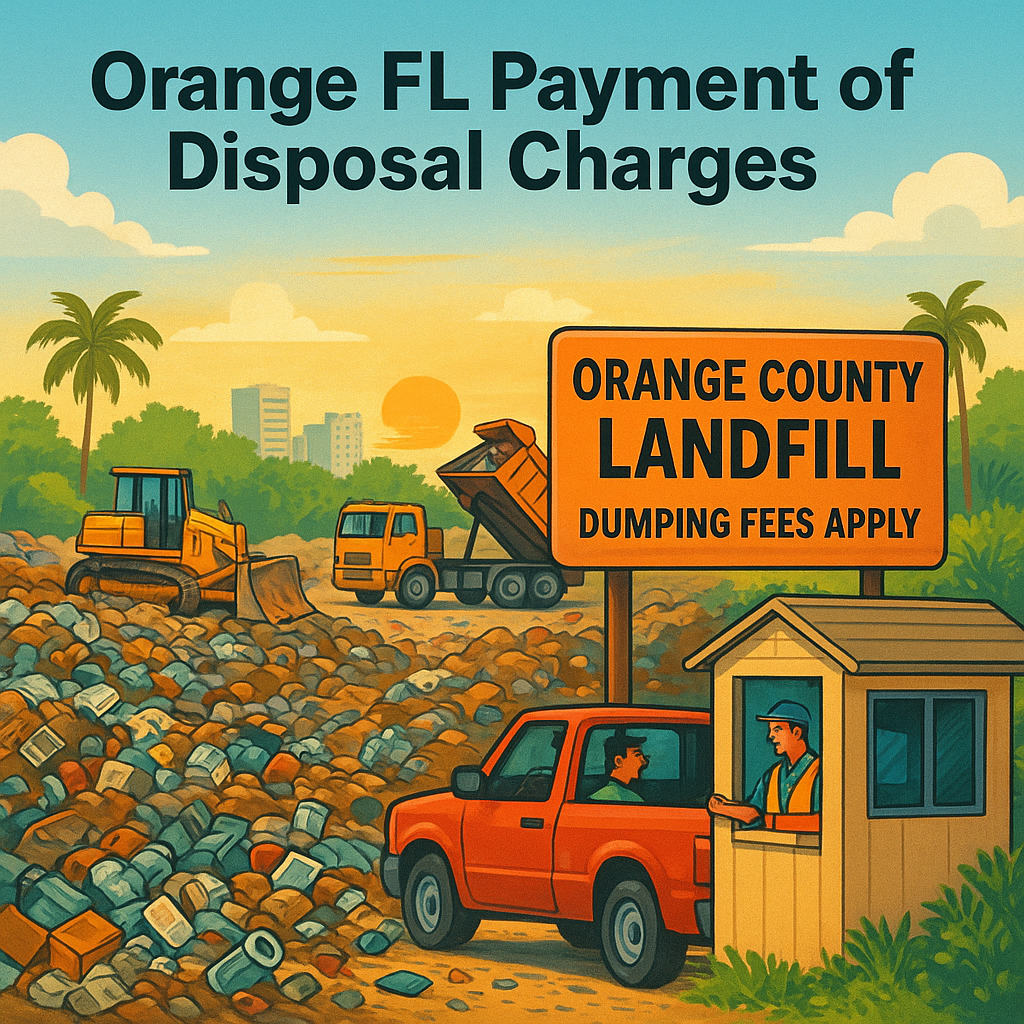
Most residential and commercial waste in Orange County finds its way to the Orange County Landfill, located at 5901 Young Pine Road in Orlando. This facility is managed by the county’s Solid Waste Division and serves as the primary hub for processing, compacting, and burying non-hazardous solid waste. There are also smaller transfer stations around the county where you can leave household garbage and yard waste, but if you’re hauling a trailer full of construction debris or a truck bed of old furniture, the Young Pine Road landfill is where you’ll likely end up.
Before you hitch up that trailer, it’s smart to know a few basics. The landfill accepts a lot of things – household trash, bulky items, clean yard waste, and even certain types of commercial debris – but it’s not a free-for-all. Hazardous materials, liquid waste, unapproved chemicals, and special items like whole tires usually have different rules or require a trip to a separate drop-off. Checking the accepted materials list online will save you a frustrating turn-around.
Breaking Down the Disposal Fees in Orange County, FL
Your final cost to dump something depends on two things: what you’re tossing and how much of it you have. Orange County uses weight as the primary measuring stick. Vehicles are weighed on a giant scale when they enter and again when they leave. The difference is your bill. Let’s look at the common categories:
Residential and Routine Household Waste
If you’re just a regular resident cleaning out your house, you’ll most likely pay what’s known as the municipal solid waste tipping fee. This rate covers everyday garbage that can’t be recycled or composted. The exact dollar amount per ton can change with each fiscal year, but as a rough ballpark, you can expect something in the neighborhood of $40 to $46 per ton. That might sound abstract, so picture this: an average pickup truck bed loaded loosely with bagged household trash rarely tops 500 pounds. Your cost for that load could be around $10 to $12. Not too painful when you see the mountain of stuff you just freed from your garage.
Construction and Demolition Debris (C&D)
Renovating a kitchen? Replacing a roof? The ripped-out drywall, concrete, lumber, and shingles fall under construction and demolition debris. This category commonly has a different tipping fee, often a bit lower than household waste because the material is considered inert and doesn’t create the same environmental challenges as food-rotting garbage. Rates for C&D debris can hover around $38 to $42 per ton. However, loads that are mixed with a lot of trash might be charged at the higher municipal rate, so it pays to keep your debris separated.
Yard Waste and Clean Wood
Orange County takes organic material and turns it into mulch, keeping it out of the landfill cell. Because that process has value, tipping fees for clean yard waste – grass clippings, leaves, branches, and untreated wood – are often the most affordable. Sometimes this material can be processed for less than $25 per ton. That’s a great incentive to do a little separation before heading to the dump.
Special or Bulky Items
Got mattresses, tires, or appliances? These often carry surcharges or per-item fees on top of the weight-based charge because they require special handing. An old refrigerator, for example, might have a small fee to ensure the refrigerant is safely removed. Always ask the scale attendant about any unusual items you’re carrying so you aren’t surprised by an extra charge.
How Do You Actually Pay These Disposal Charges?
At the Young Pine Road landfill, paying is pretty straightforward for the everyday visitor. You drive onto the scale, a staff member notes your load type, and when you exit, they’ll tell you the total. Most routine residential dumpers can pay with cash, a credit card, or a debit card right at the booth. If you’re bringing material in a standard passenger vehicle like an SUV or a pickup, the process is quick – usually just a few minutes.
Things shift a little when you’re a business running multiple trucks through the gate every day. Dump truck drivers, waste haulers, and landscaping companies can’t exactly be fumbling for a company credit card every four hours. That’s where an account system and the concept of a payment bond come into the picture.
What Is a “Payment of Disposal Charges Tipping Fees Bond” Anyway?
Here’s a phrase that can make your head spin if you’re not familiar with it. Let’s strip away the formal language. A payment bond in this context is essentially a financial guarantee. It’s a promise secured by a third party – usually a surety or insurance company – that Orange County will get paid the dumping fees owed, even if the hauler or business doesn’t pay up themselves.
Imagine you run a collection service that picks up trash from apartment complexes. You might make a hundred trips to the landfill in a month, racking up tens of thousands of dollars in disposal charges. Orange County trusts you to pay that invoice, but they also want a safety net. The bond is that safety net. If your business closes down unexpectedly or falls behind on payments, the county can make a claim against the bond and recover the money. It’s similar to a security deposit for a rental apartment, except the bond company is the one backing the promise.
Who Needs This Bond and Why?
Not everyone who throws away a bag of garbage needs to worry about a tipping fee bond. This requirement typically applies to commercial entities that establish a charge account with the county for ongoing dumping. If you want the convenience of billing after disposal, the county will often ask for a payment of disposal charges bond before they open that account. The bond amount might be based on your estimated monthly disposal volume, ensuring the county is protected against non-payment.
It’s also common for contractors working on public projects within Orange County. If a construction company is hired for a municipal job, the contract may require them to legally dispose of all construction waste at an approved facility and guarantee that the fees are paid in full. The bond acts as a safeguard so that taxpayers don’t end up footing the bill for abandoned dump costs. In short, it’s all about financial accountability and making sure the waste stream doesn’t get interrupted by unpaid debts.
Navigating the Bond Process Without the Headache
If you discover that your business needs one of these bonds, don’t panic. The process is fairly routine. First, you’ll typically get an exact bond amount from Orange County’s Solid Waste Division based on your anticipated usage. Then, you’ll reach out to a surety bond provider — the same kind of company that issues contractor license bonds or notary bonds. The provider evaluates your business’s credit and financial history and then offers a premium, which is a small percentage of the total bond amount. That premium is the cost you pay, not the full bond amount. Once the paperwork is signed and the bond is delivered to the county, your account is activated, and you can start enjoying the convenience of invoiced billing.
Smart Ways to Keep Your Disposal Costs Down
Whether you’re a homeowner making a once-a-year trip or a business owner managing a fleet, nobody loves watching money get buried in a landfill. A few simple habits can help you keep those Orange County FL landfill tipping fees in check.
- Separate loads carefully. Mixing clean yard waste with household trash turns cheap organic material into expensive municipal solid waste. Keep them apart.
- Recycle and donate before you dump. Gently-used furniture, working appliances, and architectural salvage can often be donated to Habitat for Humanity ReStore or similar outlets. Less weight at the scale means a smaller bill.
- Compress your load. Air pockets take up space but add zero weight. However, don’t confuse this with adding dirt to make the load heavier – a packed-down, well-arranged truck bed just ensures you aren’t making extra trips.
- Check for resident programs. Orange County occasionally hosts hazardous waste collection events or offers vouchers for large-item disposal. A quick visit to the county’s solid waste website might reveal some pleasant cost-saving opportunities.
Why Understanding the System Matters
Nobody daydreams about landfill fee structures, and that’s perfectly fine. But having a clear picture of what to expect before you pull up to the scale at Young Pine Road turns what could be a stressful, confusing errand into a quick chore. It also helps local businesses stay compliant and keep their operations running smoothly. The bond requirement that sometimes feels like just another bureaucratic hurdle is actually a thoughtful tool that protects the county’s ability to manage waste for all of us, without unexpected financial hiccups.
So, the next time you fill up that truck bed or rent that dump trailer, you’ll know exactly how the charges work: the scale weighs your load, the friendly staff figures out which material rate applies, and you pay for exactly what you bring. And if your business requires that extra layer of financial assurance, a payment of disposal charges tipping fees bond is simply your partner telling the county, “We’ve got you covered.”
Armed with this knowledge, you’re ready to tackle any disposal project with confidence – and maybe save a few dollars while you’re at it. Happy (and responsible) dumping!