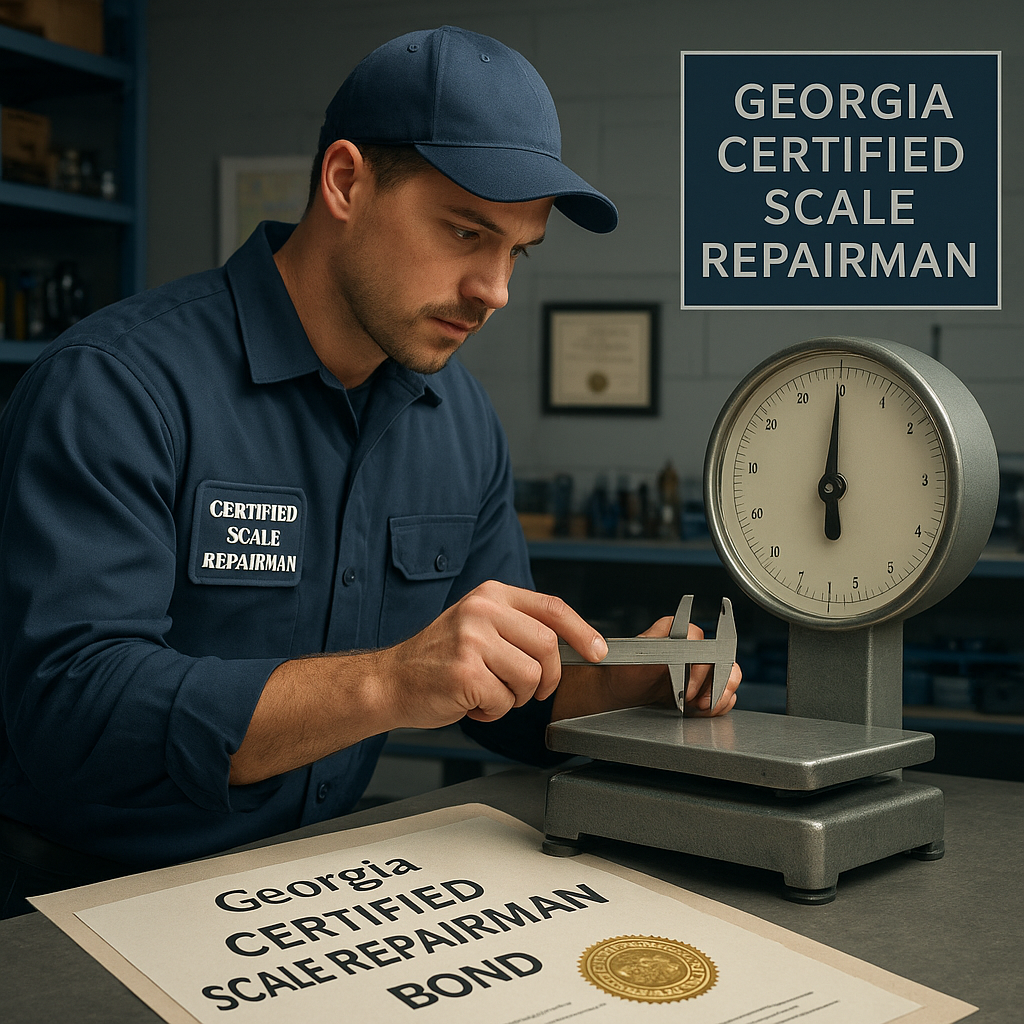
Have you ever stopped to think about how a grocery store scale knows exactly how much your apples weigh? Or how a truck scale can accurately measure thousands of pounds of cargo? Behind every honest weight measurement is a network of certified professionals who keep those scales calibrated and working properly. In Georgia, anyone who repairs or services commercial scales for a living must follow special rules set by the Commissioner of Agriculture. One of those key requirements is something called the Georgia Certified Scale Repairman’s Bond. If that sounds complicated, don’t worry. Let’s break it down in simple, everyday language so you can understand exactly what it is, why it matters, and how it protects you.
What Is a Georgia Certified Scale Repairman’s Bond?
A Georgia Certified Scale Repairman’s Bond is a type of financial guarantee. It’s not an insurance policy for the repairman—it’s a promise designed to protect the public and the state. You can think of it like a security deposit that backs up a professional’s work. If a scale repairman does something wrong, like performing faulty repairs that lead to inaccurate weight readings, the bond can provide money to fix the situation. This bond is required by the Georgia Department of Agriculture under the oversight of the Commissioner of Agriculture State of GA.
The bond involves three parties. First, there’s the scale repairman (called the principal). Second, the state agency requiring the bond (the obligee)—in this case, the Georgia Department of Agriculture. Third, there’s the surety company that issues the bond. If the repairman breaks the rules or acts unethically, a claim can be filed against the bond. The surety company would then pay out up to the bond’s limit, and the repairman must eventually repay that money. It’s a safety net that keeps everyone honest.
Why Does Georgia Require This Bond?
Imagine walking into a farmer’s market and buying a pound of honey, only to find out later that the scale was off by several ounces. Over time, those small errors add up, costing you real money. Scales play a silent but critical role in our daily transactions—from the deli counter to the shipping dock. If a repairman fails to properly fix or certify a scale, businesses might unknowingly cheat customers or make costly shipping mistakes. That’s where the bond comes in.
The Commissioner of Agriculture State of Georgia wants to make sure every consumer and business can trust the scales they use. The bond acts as an official layer of protection. It encourages scale repairmen to follow state laws, complete their work correctly, and respect the public’s financial interests. If they don’t, the bond provides a clear path for reimbursement. It’s a way to hold repairmen accountable without forcing you to go through a lengthy court battle.
Who Needs a Georgia Scale Repairman’s Bond?
Not every handyman who tinkers with tools needs this bond. The requirement applies specifically to individuals or businesses that install, service, repair, or recondition commercial weighing and measuring devices. This includes scales used in grocery stores, jewelry shops, post offices, farm supply stores, and industrial facilities. If you charge money for your scale repair services and operate in Georgia, the state likely requires you to hold a valid certification—and the bond is a mandatory part of getting that certification.
The Georgia Department of Agriculture issues the official Certified Scale Repairman license. Before you receive that license, you must provide proof of your bond. So, the bond and the certification go hand in hand. Without the bond, you cannot legally perform commercial scale repair work in the state.
How Does the Bond Work in Real Life?
Let’s paint a picture. Suppose a poultry processing plant calls in a repairman to fix their main shipping scale. The repairman rushes the job, forgets to recalibrate a sensor, and the scale starts reading 50 pounds heavier than it should. Over the next week, the plant ships out thousands of pounds of chicken, undercharging their customers by a significant margin. Once the mistake is discovered, the plant faces angry clients and lost revenue. They can file a claim against the repairman’s bond to recover some of that financial damage.
The process is straightforward. The injured party provides evidence of the error and the resulting loss to the surety company. The surety investigates. If the claim is valid, the surety pays up to the full bond amount. Later, the repairman must reimburse the surety company for every penny. This is very different from insurance, where premiums cover losses. With a bond, the repairman always bears the final financial responsibility.
How Much Does a Georgia Scale Repairman’s Bond Cost?
The bond amount required by the state is a set figure, typically a few thousand dollars. This is the maximum payout available if a claim occurs. But you don’t pay that full amount upfront. Instead, you pay a small percentage called the premium. For most applicants, the premium ranges from 1% to 5% of the total bond amount, depending on personal credit and business history. So, if the required bond is $5,000, a repairman with good credit might pay as little as $50 to $100 a year.
Even if your credit isn’t perfect, you can usually still get bonded. The premium may just be higher. Surety companies look at your financial stability to determine the risk. The process is quick, and many agencies can issue the bond within a day or two after you apply.
Steps to Get Your Bond
- Contact a licensed surety bond agency that offers bonds in Georgia.
- Provide basic personal and business information, including your Social Security number for a credit check.
- Choose the bond amount exactly as required by the Georgia Department of Agriculture.
- Pay the annual premium.
- Receive your bond form, sign it, and submit it along with your certification application.
Certification Requirements Beyond the Bond
The bond is a vital piece of the puzzle, but it’s not the only requirement. To become a certified scale repairman in Georgia, you must also demonstrate technical competence. This usually involves passing an examination or completing approved training programs that cover scale types, calibration procedures, and state regulations. The state wants to ensure you know your craft before they let you touch commercial equipment.
Once certified, you’ll need to renew your license periodically. The bond must also be renewed or kept active during your entire certification period. If your bond lapses, the state can suspend your license until you provide proof of continuous coverage. Staying on top of both deadlines is essential for anyone who depends on this work for a living.
Common Misunderstandings About the Bond
A lot of people assume the bond protects the repairman’s tools or business property. That’s not the case. The bond strictly protects the state and consumers. Another myth is that the bond covers any kind of mistake, like simple dissatisfaction with a repair. In reality, the bond only kicks in if the repairman violates the law, engages in fraud, or acts negligently in a way that causes measurable financial harm. It’s not a customer satisfaction guarantee.
Also, remember that a claim on your bond can make it harder—and more expensive—to get bonded in the future. Just like a credit score, your bond history follows you. So, doing high-quality work isn’t just good for your reputation; it keeps your bonding costs low.
Why This Matters to Everyday Georgians
You might never repair a scale, but you certainly use them. From the gas pump that tells you how much fuel went into your car to the postal scale that calculates your shipping fee, accurate measurements are woven into the fabric of daily life. When the Commissioner of Agriculture State of GA enforces bonding requirements, it creates a chain of trust. Repairmen are motivated to do their jobs right, businesses can operate fairly, and you can shop with confidence.
Think of the bond as a quiet guardian. You don’t see it working, but it’s there, protecting your purchases and ensuring that a pound is truly a pound. It’s one of those behind-the-scenes regulations that makes the marketplace safer for everyone.
Frequently Asked Questions (Without the Formal Q&A)
You might wonder if a business that repairs its own scales needs this bond. Generally, if you only fix equipment owned by your own company and don’t offer services to the public, the rules may be different. But as soon as you take payment from a third party for repair work, the bond requirement typically applies. It’s always wise to check directly with the Georgia Department of Agriculture to confirm your specific situation.
Another question people have is about the bond’s duration. Most bonds run on an annual cycle. You’ll need to pay the premium each year to keep the bond active. The state may also require you to file a continuation certificate or a new bond form with each license renewal. Forgetting to renew on time can pause your ability to work legally, so set reminders well ahead of the expiration date.
Making Sense of the Legal Language
The documents associated with the Georgia Certified Scale Repairman’s Bond can sometimes read like a thick legal stew. Words like “obligee,” “indemnity,” and “surety” get tossed around. But once you understand the core promise, it’s much simpler: you agree to follow the rules, and if you don’t, there’s a fund available to make things right. That’s the heart of it. Surety companies are there to help you understand the fine print, and many offer online resources that translate bond forms into clearer language.
If you’re preparing to apply, take a moment to read the bond form fully. Notice the bond amount, the named obligee (the state), and any special conditions. Being informed helps you avoid missteps that could lead to a claim later on.
Protecting Your Business and Your Customers
For scale repairmen, this bond is more than a bureaucratic hurdle. It’s a marketing tool. When you can tell clients you’re bonded and certified by the state, you instantly stand out from unlicensed competitors. It tells your customers that you’re serious about your trade and that there’s a financial safety net backing your work. In a world where trust is hard to earn, a bond helps you build credibility from day one.
For everyone else, knowing about this bond removes some of the mystery behind everyday transactions. It’s reassuring to realize that a government agency, under the Commissioner of Agriculture State of GA, has your back when it comes to fair weights and measures. The next time you see a scale, you can appreciate the quiet system that keeps it honest.
Final Thoughts
The Georgia Certified Scale Repairman’s Bond may sound like a small detail in a big world, but it plays a huge role in keeping commerce fair. Whether you’re pursuing a career as a repairman or simply curious about what goes on behind the scenes, understanding this bond gives you a clearer picture of how trust is built into the marketplace. By ensuring that repairmen are accountable for their work, the state helps protect every single Georgian who steps on a scale, ships a package, or buys goods by weight.
So, if you’re shopping at a local market, pause to appreciate the invisible threads that hold the system together—and if you’re gearing up to become a certified repairman, embrace the bond as your badge of trustworthiness. It’s a small investment that makes a big difference.